
-
cryptoteats
- No Comments
Open any crypto price-tracking site and “market cap” is usually the very first column, sitting above price, volume and every other statistic. It’s the number most traders use to size up an asset at a glance, yet it’s also one of the most misunderstood terms in the market — many beginners assume it simply means “how much a coin costs” or “how much money people have put into it.” Neither is accurate.
This guide explains what crypto market cap actually is, how it’s calculated, what it can and can’t tell you, and how to use it sensibly when comparing coins.
What Does Market Cap Mean in Crypto?
Market capitalisation, or market cap, is the total value of every coin or token currently in circulation for a given cryptocurrency. It’s a concept borrowed directly from traditional stock markets, where it’s used to size up publicly listed companies, and it plays the same role in crypto: ranking assets from largest to smallest and giving a rough sense of scale.
When someone says Bitcoin has “the biggest market cap,” they mean that the combined value of every Bitcoin in existence is larger than that of any other cryptocurrency — not that a single Bitcoin costs more than every other coin (plenty of lower-priced coins are worth more per unit than some higher-priced ones, once supply is factored in).
How Is Crypto Market Cap Calculated?

The Basic Formula
Market cap follows a simple formula:
Market Cap = Current Price × Circulating Supply
So a coin trading at £2 with 500 million coins in circulation has a market cap of £1 billion. A coin trading at £0.02 with 100 billion coins in circulation also has a market cap of £2 billion — despite costing a tiny fraction of the price. This is exactly why price alone is a poor way to judge a coin’s size or standing in the market.
Circulating Supply vs Total Supply vs Max Supply
Supply isn’t a single number, and mixing these up is one of the most common sources of confusion:
- Circulating supply — the coins currently available and trading in the open market. This is the figure used in the standard market cap calculation.
- Total supply — circulating supply plus any coins that have been created but are locked, reserved, or not yet released.
- Maximum supply — the absolute cap on how many coins can ever exist. Bitcoin’s maximum supply is fixed at 21 million; some cryptocurrencies, including Ethereum, have no fixed maximum.
The gap between these figures matters. A project with a small circulating supply but a much larger total or maximum supply may see new coins enter the market over time, which can affect price and market cap independently of demand.
Market Cap vs Coin Price — Why a Cheaper Coin Isn’t “Better Value”
A common beginner mistake is assuming a coin priced at £0.001 is “cheap” and has more room to grow than a coin priced at £50. Price per coin tells you nothing about value on its own — it only reflects how the total supply happens to be divided up.
Two coins can have identical market caps while having wildly different prices, simply because one has far more coins in circulation than the other. When comparing crypto assets, market cap is a far more meaningful reference point than price per unit.
Market Cap vs Fully Diluted Valuation (FDV)
Fully diluted valuation (FDV) estimates what a coin’s market cap would be if its entire maximum supply were already in circulation, using the current price:
FDV = Current Price × Maximum (or Total) Supply
Comparing market cap to FDV is a useful gut-check before investing. A large gap between the two usually means a significant number of tokens are still locked up — held by the team, early investors, or a foundation — and scheduled to enter circulation later. As those tokens unlock, the increased supply can put downward pressure on price, since more coins are competing for the same demand. This dilution risk is one of the more overlooked factors in newer or smaller crypto projects.
Large-Cap, Mid-Cap and Small-Cap Cryptocurrencies
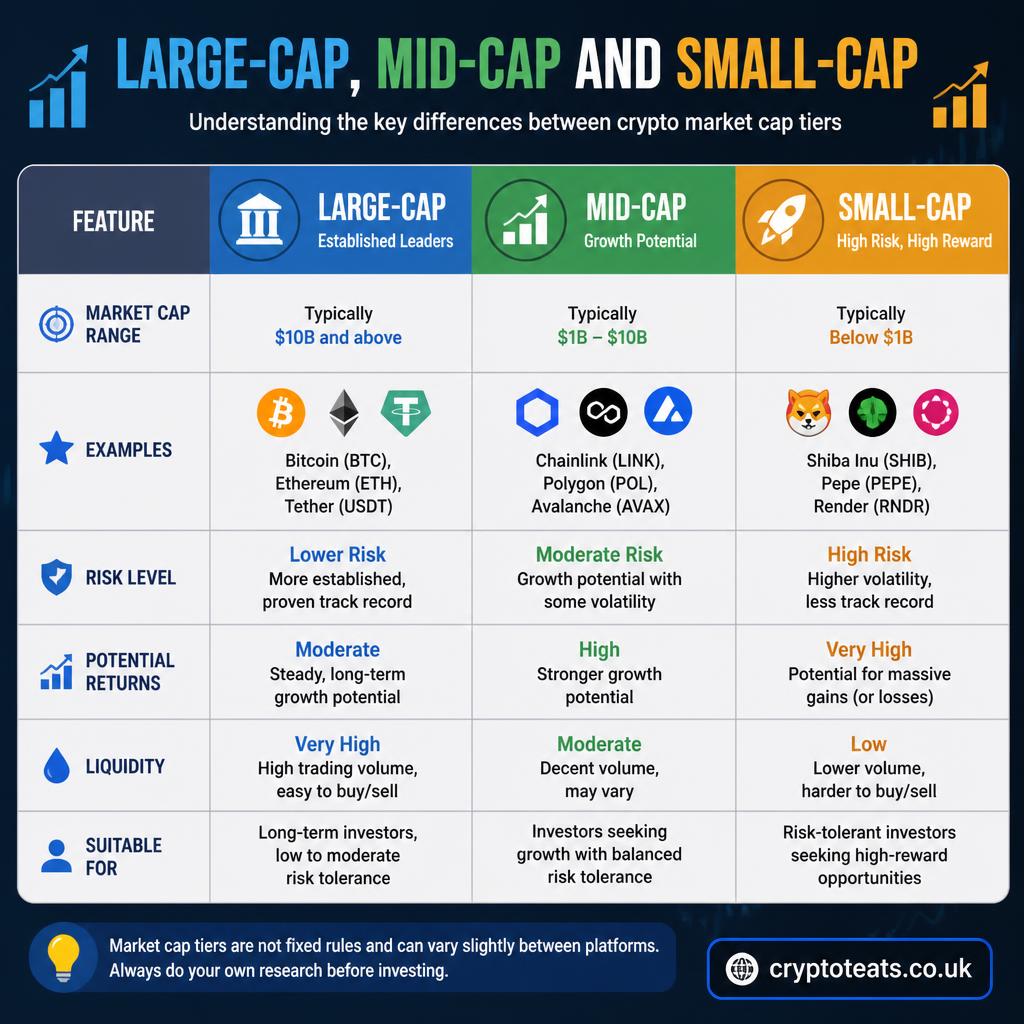
As with equities, cryptocurrencies are often grouped into broad tiers based on market cap:
| Tier | Rough Characteristics |
|---|---|
| Large-cap | Established, widely traded coins (e.g. Bitcoin, Ethereum). Generally more liquid, with lower relative volatility and a longer track record. |
| Mid-cap | Reasonably established projects with meaningful adoption, but more price sensitivity than large-cap coins. |
| Small-cap | Newer or niche projects. Can offer higher growth potential but carry significantly higher volatility and liquidity risk. |
A higher market cap generally suggests a more established, more liquid asset — but it isn’t a guarantee of quality or future performance. Large projects have collapsed, and small projects have grown substantially; market cap describes an asset’s current size, not its trustworthiness.
What Market Cap Doesn’t Tell You
It’s Not the Same as Money Invested
One of the most persistent myths is that a coin’s market cap represents how much real money has flowed into it. It doesn’t. Market cap simply applies the last traded price across every coin in circulation. A relatively small trade can move the price of a thinly traded coin, changing its entire market cap without any proportional new investment actually taking place.
It Doesn’t Measure Liquidity on Its Own
A coin can display a large market cap while still being hard to buy or sell in size, particularly if trading volume is low or most coins are held by a small number of wallets. Before treating market cap as a sign of stability, it’s worth checking trading volume separately — the two metrics answer different questions.
What Is Market Dominance?

Market dominance refers to a specific coin’s market cap as a percentage of the entire crypto market’s combined value. Bitcoin dominance, for example, shows what share of total crypto market cap is held by Bitcoin alone. Rising dominance for a coin can indicate capital moving toward it relative to the rest of the market, while falling dominance often coincides with capital spreading into altcoins.
How to Use Market Cap When Researching a Crypto Asset
Used properly, market cap is a starting point for research rather than a final answer. A practical approach:
- Check the market cap to understand where the asset sits relative to the wider market.
- Compare market cap to FDV to gauge future dilution risk.
- Cross-check trading volume to assess real liquidity.
- Look at how circulating supply is distributed before assuming a high market cap equals low risk.
Common Mistakes UK Investors Make with Market Cap
- Judging a coin’s potential purely by its unit price rather than its market cap.
- Assuming market cap reflects the total money actually invested in a project.
- Ignoring the gap between circulating supply and maximum supply, and getting caught out by later token unlocks.
- Treating a high market cap as a guarantee of safety, without checking liquidity or volume separately.
- Comparing market caps across coins without checking whether circulating or fully diluted figures are being used consistently.
FAQs
Does a low coin price mean a cryptocurrency is undervalued?
Not necessarily. A low price usually reflects a large circulating supply rather than genuine undervaluation. Market cap gives a more accurate comparison between assets than price per coin.
Why does Bitcoin have such a high market cap if I can buy a fraction of a coin cheaply?
Bitcoin’s market cap reflects the value of all 19+ million coins currently in circulation, not the price of the whole coins available to buy. You can own a small fraction of one Bitcoin while its total market cap still runs into the trillions.
Is a high market cap coin always a safer investment?
It generally suggests a more established and liquid asset, but it isn’t a guarantee against losses. All cryptocurrency investments carry risk, including large-cap ones.
Where can I check a coin’s live market cap?
Crypto price-tracking sites and most major exchanges display live market cap figures alongside price and volume for each asset.
Understanding the number before you use it
Market cap is one of the quickest ways to size up where a cryptocurrency sits in the wider market, but it works best alongside other figures — FDV, circulating supply, and trading volume — rather than in isolation. If you’re still getting to grips with the basics, it’s worth reading our guide on what cryptocurrency actually is before comparing individual coins by market cap.
